Fine hair gains more volume if you do three things right: don’t weigh down the roots while washing, blow-dry the roots upward instead of flat, and set the style while the hair cools. You don’t need expensive products or a new hair color to achieve this. It’s mainly about technique and using less product. Below, you’ll find a step-by-step guide explaining what works, why it works, and which mistakes will cause the volume to collapse within an hour. You’ll also learn how to create a blowout at home that’s perfect for fine hair.
In a nutshell
-
Apply conditioner only from your ears down. If conditioner gets on your roots, your hair will go flat right away.
-
First, blow-dry the roots, working against the direction of hair growth. That's where you'll get volume—not in the lengths.
-
Let each section cool on the brush or in your hand. That's the only way it will hold its shape.
-
Less product creates more volume. A small amount of light mousse or volumizing powder works better than applying layer upon layer.
-
Limit the heat. The hotter the hair gets, the more damage occurs to the surface, and damaged hair loses its volume more quickly.
Table of Contents
Why Fine Hair Flattens So Quickly
Fine hair refers to the thickness of each individual strand, not to the number of strands you have. Each strand has a small cross-section. So you can have a lot of hair that still lacks body. Thin hair, on the other hand, means there are fewer strands per square centimeter. These two conditions often occur together, but the approach differs. Fine hair is primarily a styling issue. With thin hair or hair that’s thinning, the scalp also plays a role.
Because each strand of hair is so light, you notice everything that ends up on it. Sebum from your scalp, conditioner, oil, silicones, or a layer of styling product: fine hair carries it all, and the heaviest part is at the roots. That’s why with fine hair, you often see that it looks great in the morning but lies flat against your head by the afternoon. The strands themselves haven’t changed—there’s just more weight on them.
What does "limp hair" mean?
Lifeless hair lacks bounce. It hangs limply, doesn’t hold a curl or wave, and quickly looks greasy or flat. This is usually due to a combination of fine hair, using too many products at the roots, and a drying method that flattens the hair against the scalp. The good news: you can do something about all three.
Don't expect miracles from a bottle
The Hair Care Trends series on fine hair states that the number of hair follicles you’re born with is a fixed number. A healthy scalp helps in the long run, but you’re talking about months, not an instant burst of volume. So a product that promises “instantly thicker hair” mainly changes how your hair falls, not how thick it is. Styling is a cosmetic solution, and that’s perfectly fine. Once you know that, you can make better choices about where to spend your money and time.
Volume starts right in the shower
Half of how your hair looks later depends on what you do in the shower. Even with the best blow-drying technique, you won't get any lift at the roots if they're full of conditioner.
Apply shampoo to the scalp, not the lengths of your hair. Massage the shampoo into the roots, where sebum and product residue accumulate. The lather you rinse out is enough for the lengths of your hair. Rinse thoroughly and for a long time, because residue weighs down fine hair.
Choose a mild shampoo. Dermatologist Jetske Ultee recommends that people with fine hair avoid shampoos containing “film-forming agents” or polymers, as these can leave the hair limp and greasy. According to her, a shampoo for fine hair doesn’t need to be heavily conditioning either. So take a critical look at formulas that promise “extra care” or “silky soft”—they often work against you.
Apply conditioner starting at your ears. This is the biggest difference between hair that lies flat and hair that retains volume. Apply conditioner only to the lengths and ends, starting at about ear level. This keeps the roots light and clean. Don’t use a hair mask too often, and apply it only to the ends.
Wash your hair based on your scalp’s needs. There’s no one-size-fits-all rule. If your roots get oily after just one day, washing more often with a mild shampoo is better than putting up with flat hair and dry shampoo. If you have a sensitive scalp or are losing a noticeable amount of hair, have it checked by your doctor or a dermatologist first before experimenting with products.
Blow-Drying for Volume, Step by Step
This is where you really make a difference. Hairstylists build volume at the roots. They mainly smooth out the lengths. Here’s how to do it at home:
-
Pat, don't rub. Squeeze the water out of your hair with a microfiber towel or an old cotton T-shirt. Rubbing roughens the outer layer and causes frizz.
-
Let it dry a little first. Van Guhl recommends letting your hair air-dry for about five minutes after washing it before styling it. Blow-drying hair that’s still dripping wet just takes extra time and exposes it to extra heat.
-
Apply a small amount of light mousse or volumizing spray to the roots. A dollop about the size of a tangerine is more than enough for medium-length, fine hair. Work it through with your fingers all the way down to the scalp.
-
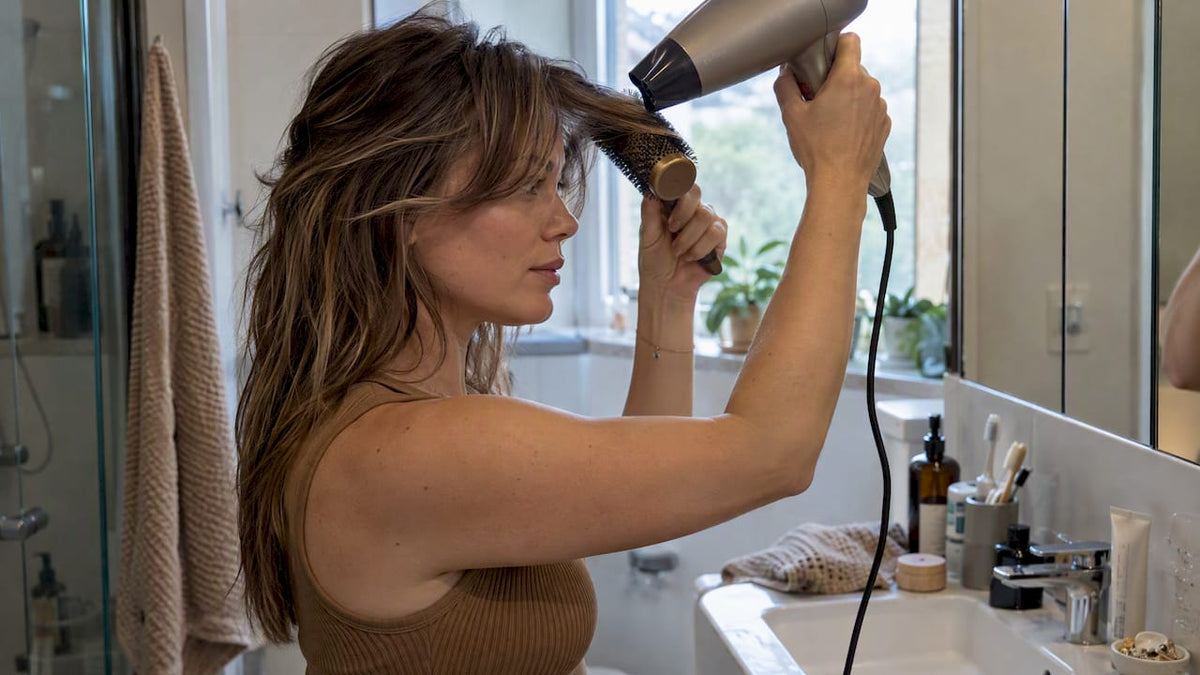
Blow-dry the roots against the direction of hair growth. Tilt your head forward, or use your fingers to lift the roots slightly and direct the airflow from below toward the roots. Also blow-dry in the opposite direction of your part. This will lift the hair away from your scalp.
-
Only then should you style the lengths. Once the roots are about 80 percent dry, continue using a brush. Direct the airflow from the roots to the ends. This will lay the cuticles flat and give you shine instead of frizz.
-
Set your style with cool air. Your hair takes on its shape as it cools. A few seconds of cool air on each section—or simply letting the section sit on the brush for a moment—will keep your volume looking fresh for hours.
Keep the hair dryer moving and don’t hold it against your hair. In a Korean study on hair damage caused by blow-drying, drying the hair from a distance of 15 cm with a constantly moving hair dryer caused less damage than letting the hair air-dry. At higher temperatures, damage to the hair’s surface increased. So here’s what you want to do: use moderate heat, keep your distance, and keep moving the dryer.
A blowout for fine hair

A blowout is a blow-dry style that features volume at the roots, light, airy lengths, and soft movement at the ends. LINDA describes the voluminous blowout as a look characterized by volume at the roots and light, airy lengths, with layers that enhance the effect. This type of blowout is ideal for fine hair, as long as you don’t make it too heavy.
Here's how to put it together
-
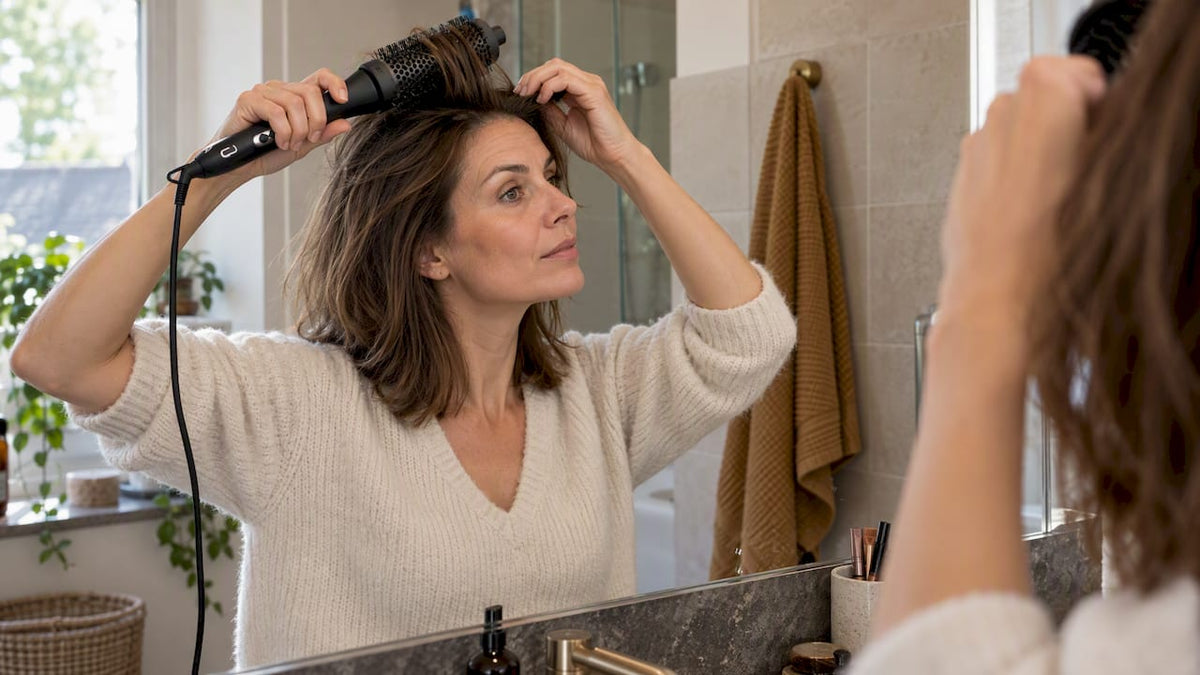
Work in sections. Divide your hair into four to six sections and secure the top section with a clip. Start at the bottom near your neck and work your way up to the top of your head. The top layer is what people see, so it gets the most attention.
-
Use small sections. Fine hair slips off a brush easily. Take sections that are no wider than the brush itself.
-
Direct the hair toward the crown. Pull each section straight up on top of your head, or slightly toward the opposite side, and blow-dry it in that direction. This will keep the roots in place when you let go of the section.
-
Twist the ends inward or outward, but don't twist them too tightly. A loose twist looks more natural on fine hair and lasts longer.
-
Let it cool. Leave the brush in the last section for a moment, or roll it up with a lint roller until it’s cool. For fine hair, this is the step that ultimately determines whether the blowout will hold.
Which brush or tool is best for fine hair?
The classic method is to use a hair dryer with a round brush. It gives great results, but you need both hands, and it takes practice. The Dutch Hairdressers' Union recommends a hair dryer with multiple heat and speed settings, plus a round brush with natural bristles and a heat protectant. It works, but for many women, it’s exactly the hassle that makes them give up in the morning.
| Method | What it does | Benefit b | Please note |
|---|---|---|---|
| Hair dryer with a round brush | Drying and Shaping with Two Separate Tools | A lot of control over the stroke | It takes practice and time, and your arms get tired |
| Heat Brush (Volume Brush) | Style dry hair with a heated brush | Effortless volume, movement, and a light, airy blowout look | Work in small sections; don't go over the same section too often |
| Hair dryer upside down, without a brush | Instant volume at the roots | Quick and easy | Strands become less smooth, and there is a greater chance of frizz |
| Curling iron or straightener after blow-drying | Style in dry hair | Tight strokes | Extra heat on dry hair, and fine hair quickly becomes flat again |
A heated brush is an easy way to create a voluminous blowout look at home. The Navado Bounce Brush is designed for use on dry hair. The heated 38 mm brush helps create volume at the roots, movement along the lengths, and a beautiful shape at the ends. This gives you that full, airy finish without having to use a hair dryer and a round brush at the same time.
Volume on top of your head
The crown and the top of your head are the first areas to sag. These tips will help you prevent that:
Change your part. Hair that has been falling the same way for years will naturally lie flat on that side. If you move your part a few centimeters to the other side, the roots will immediately stand up. A zigzag part also hides a part that looks a bit wide or thin.
Blow-dry the top layer last and on its own. If the rest of your hair is already dry, the top is often already half-dry, making it difficult to lift. First, lightly mist that layer with a plant sprayer, and then blow-dry it again to lift it.
Apply volumizing powder to dry hair. This is a light, matte powder that makes the hair slightly rough, so the strands support each other. Here's how to use it:
-
Part your dry hair where you want volume, usually on top or at the crown.
-
Sprinkle a very small amount directly on the base of the hair. It's better to use too little than too much.
-
Massage it in with your fingertips and lift the hairs as you massage.
-
Repeat on two or three sections next to it, then shake your hair out.
If you use too much, your hair will feel sticky and may look dull. Some powders may be visible on dark hair, so test it first on an inconspicuous spot.
Let your hairstyle do the work
No amount of styling can compete with a haircut that pulls your hair down. Long, heavy hair that’s all one length flattens the roots. Here are a few things to discuss with your hairstylist:
-
Medium-length or shorter. The shorter it is, the less weight there is on the roots. With fine hair, a lob or a bob that falls just above the shoulders usually looks fuller than hair that reaches halfway down your back.
-
Layers, but in moderation. A few soft layers at the top add movement. Too many layers can actually make the ends of fine hair look thin and stringy.
-
Blunt ends. A neatly trimmed bottom makes the hair look thicker than thinned-out ends.
-
Ask for a hairstyle that you can blow-dry yourself. Show your stylist how to do it and ask which side looks best for your part.
Mistakes That Undo Your Volume
Too much product. It’s tempting to layer mousse, spray, powder, and serum. Michael Lendon of Aveda says in *Elle* that with fine hair, it’s all about striking a balance between smoothness and volume: using too much product causes the hair to lose its natural movement. So choose just one volumizing product at a time, and at most, a light anti-frizz product for the ends.
Oil or serum at the roots. Oil should only be applied to the ends—and even then, just one or two drops. Anything applied higher up will be visible within a few hours.
You're always running your hands through your hair. Sebum and oil from your fingers weigh down the roots. If you want to freshen up your hair, shake it loose starting at the roots.
Too many chemical treatments. Dermatologist Zoe Draelos says in an article on Newswise that the more often hair is treated, the more damage and the greater the risk of breakage. If you want to color your hair or get a perm, talk to your hairstylist about spacing out these treatments as much as possible. If you notice that your hair is breaking or that it’s thinning in certain areas, see your doctor or a dermatologist instead of just trying different products.
Styling with too much heat. Don't automatically set your hair dryer or styling tool to the highest setting. Fine hair dries faster than thick hair and requires less heat. Use a heat protectant, especially if you're using a curling iron after blow-drying.

Our Take on Volume in Fine Hair
We hear this from customers almost every day: they spend half an hour blow-drying their hair in the morning, they have three brushes and two curling irons, and by lunchtime their hair is already flat again. To us, that shows where the problem lies. It’s not the woman, it’s not her hair—it’s the number of steps. Every extra step means more heat, more product, and a greater chance of things going wrong.
Our approach is simple: beautiful hair doesn’t have to be complicated. With the right technique and styling tool, you can create volume, movement, and a polished finish at home. The Bounce Brush is designed to easily style dry hair and create a full, airy blowout look. Do you want to go from wet hair to a smooth, straight finish? Then the Airglide is designed for that. That way, you can choose the tool that matches the result you want to achieve.
Fine hair isn't a flaw you need to fix. It's a hair type that requires a slightly different approach: gentle washing, targeted blow-drying, and letting it cool. If you do those three things right, all you need is a good tool and a few minutes.
Create a voluminous blowout at home
Want to create more volume, movement, and shape at home? The Navado Bounce Brush 38 mm is a heated styling brush that makes it easy to style dry hair. The round, heated brush helps build volume from the roots and gives the lengths and ends a soft, full finish. This lets you create a salon-quality blowout look without having to use a hair dryer and a round brush at the same time.

Would you rather read more first? In all our blog posts, you’ll find more styling tips—for example, on how to create curls without heat, which is a great option for fine hair that needs a break.
Frequently Asked Questions
How can I get more volume on top of my head?
Blow-dry the top layer last, working against the direction of hair growth, and pull each section straight up as you dry it. Part your hair a few centimeters differently than usual, so the roots don’t fall into their usual crease. After styling, massage a small amount of volumizing powder into the roots for extra hold.
What is your hairline?
The roots are the first section of hair from your scalp—the first few centimeters. That’s where volume is created or lost. If the roots are lifted, your entire hairstyle looks fuller. If they’re flattened by conditioner or natural oils, styling the lengths won’t make much of a difference.
Can I get a blowout if I have very fine hair?
Yes. Work with smaller sections, don’t use too much styling product, and let each section cool down for a moment before releasing it. Dry your hair first, then use a heat brush like the 38 mm Bounce Brush to create volume, movement, and shape. This way, you can achieve a full, airy blowout look even with fine hair.
How long does volume last in fine hair?
That depends mainly on how clean your roots are and whether you’ve let the style cool down. With a gentle wash routine and a blast of cold air at the end, a blowout usually lasts much longer than if you let warm hair down right away. To refresh it on day two, use a little volumizing powder and give the roots a quick blow-dry.
Sources
Hair Care Trends: Fine Hair Series, Part 30—The Scalp-Follicle CircuitDr. Jetske Ultee: Shampoo Product RecommendationsGuhl: How to Transform Your Fine HairPMC: Hair Shaft Damage from Heat and Hair Dryer Drying TimeLINDA: How to Create the Perfect Blowout at HomeDutch Hairdressers’ Union: The Secrets Behind a Perfect BlowoutElle: How to Care for Fine HairNewswise: Maintaining Beautiful Hair Through Thick and Thin